Chips & Hardware
Amazon scales custom AI chip production for OpenAI and Anthropic
Amazon is scaling Trainium chip production for OpenAI and Anthropic, aiming to lower inference costs and potentially dent Nvidia’s near monopoly.
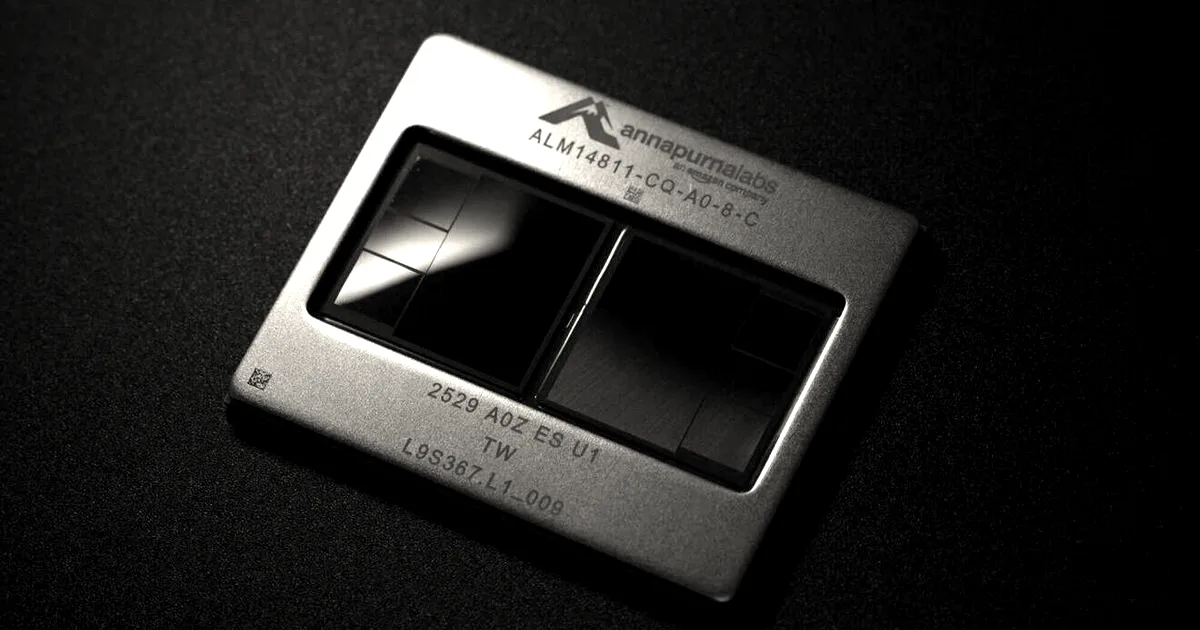
Amazon has secured a $50 billion investment deal with OpenAI, positioning AWS to supply 2 gigawatts of Trainium computing capacity. Under the deal, AWS is the exclusive provider for OpenAI’s new AI agent builder. However, the partnership faces a potential legal haze. The Financial Times reported that Microsoft may believe OpenAI’s deal with Amazon violates its own deal with OpenAI.
To support this capacity, Amazon is leveraging its Trainium chips. According to the AWS chip team, Trainium now supports PyTorch, an open-source framework. Mark Carroll, director of engineering, stated that transitioning requires only a simple one-line change and a recompile to run on Trainium. For inference—the process of running an AI model to generate responses—Amazon asserts that Trainium chips running on its Trn3 UltraServers cost up to 50% less to run for comparable performance than classic cloud servers. The hardware setup utilizes custom networking components called Neuron switches and trays that house AI chips, known as sleds.
This silicon strategy is rooted in Amazon’s January 2015 acquisition of chip-designing unit Annapurna Labs for about $350 million. Industry experts suggest Trainium chips could potentially dent Nvidia’s near monopoly on AI hardware. The latest Trainium3 is a 3-nanometer chip manufactured by TSMC, while other chips are produced by Marvell. The team’s work has gained external validation; Apple lauded Amazon’s chip team in 2024. Additionally, AWS recently partnered with Cerebras Systems to integrate its inference chips with Trainium-powered servers.
At Amazon’s chip-designing lab in Austin—an area sometimes called Austin’s Silicon Valley—engineers manage the silicon bring-up, which is the process of activating a new chip for the first time to verify its design. Kristopher King, the lab’s director, described the process: “A silicon bring-up is when you get the chip for the first time, and it’s like a big overnight party. You stay here, like a lock-in” This 24/7 testing supports a massive deployment across AWS infrastructure:
- 1.4 million Trainium chips are currently deployed across all generations.
- Over 1 million Trainium2 chips are running Anthropic’s Claude model.
- 500,000 chips are active in Project Rainier, a massive compute cluster that went live in late 2025 to support Anthropic.
Why it matters
Amazon is scaling its custom Trainium chip production to support major AI partners like Anthropic and OpenAI, aiming to reduce reliance on Nvidia and lower AI inference costs.