AI & Models
Anthropic launches Claude Tag for persistent Slack collaboration
Anthropic is launching Claude Tag, an always-on AI teammate for Slack that provides persistent context and memory to help teams manage tasks and organizational knowledge.
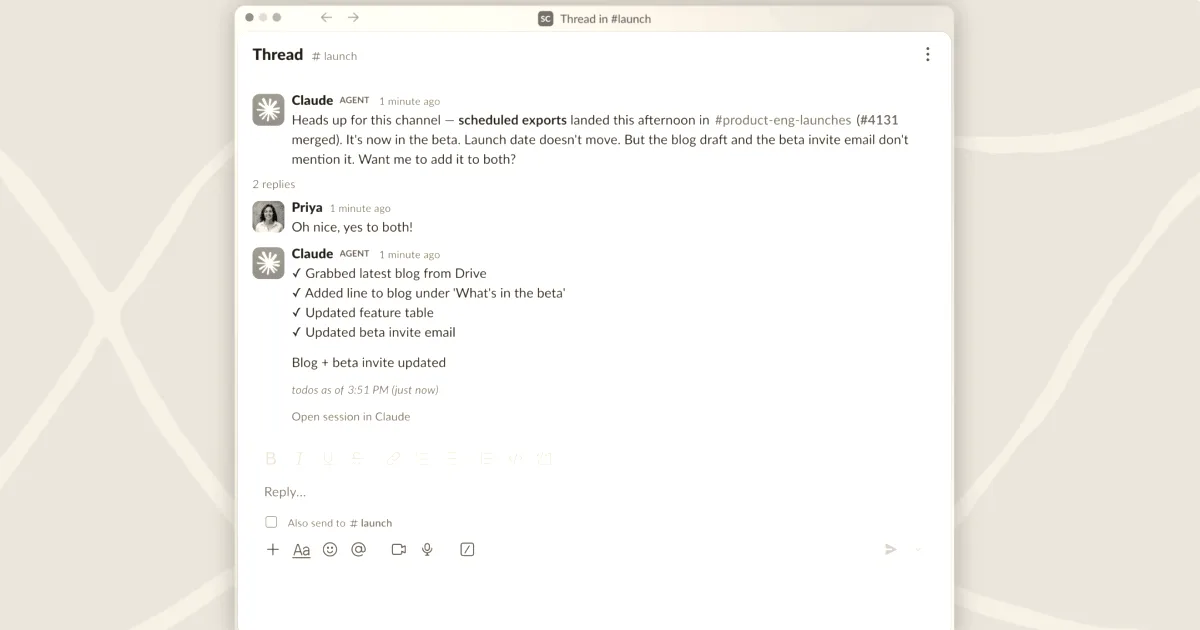
On June 23, 2026, artificial intelligence developer Anthropic introduced a new service called Claude Tag, which functions as an always-on AI teammate inside the messaging platform Slack. The integration allows users to tag @Claude directly in chats to provide insights and assign tasks. Unlike standard on-demand chat integrations, Claude Tag adds a layer of persistent context and memory to Slack interactions. This persistent context allows the AI to remember past interactions and organizational data, marking a shift in how teams interact with AI models in their daily workflows.
The service features an ambient mode, where the AI proactively engages in chat to update teams and follow up on tasks. If granted permission, Claude Tag can also automatically gather facts from elsewhere in the organization to inform its responses. This persistent memory allows multiple team members to interact with a single Claude identity within a shared channel. According to Anthropic, “anyone can see what Claude has been working on, and can pick up the conversation from where the last person left off.” The company notes that as the AI follows along with a channel, it learns more about the work being done. This is intended to create the experience of working with a real colleague that can produce work publicly with greater context and understanding.
The beta version of Claude Tag is available for Slack users on the Claude Enterprise and Claude Team subscription tiers, which serve enterprise and team customers respectively. With this launch, Anthropic enters a highly competitive race to control the intelligence layer of enterprise data. It competes directly with Microsoft, which uses Microsoft Graph as the underlying data layer for its AI tools. Other major enterprise players, such as Snowflake and Databricks, are positioning their platforms as the back-end support containing the tacit organizational knowledge that AI agents need to tap into. Meanwhile, Glean, an enterprise search and intelligence platform, is building its own layer to connect models with internal company data.
Why it matters
The shift from on-demand AI to persistent, context-aware agents represents a critical evolution in enterprise software, as companies race to turn tacit organizational knowledge into actionable data. By embedding memory directly into communication channels, developers are attempting to move AI from a simple query-and-response tool to an active participant in business operations.