Chips & Hardware
Apple debuts M5 Pro and M5 Max chips with Fusion Architecture
Apple debuted its M5 Pro and M5 Max chips, featuring a new "Fusion Architecture" that delivers up to 30% faster CPU performance and significant AI compute gains.
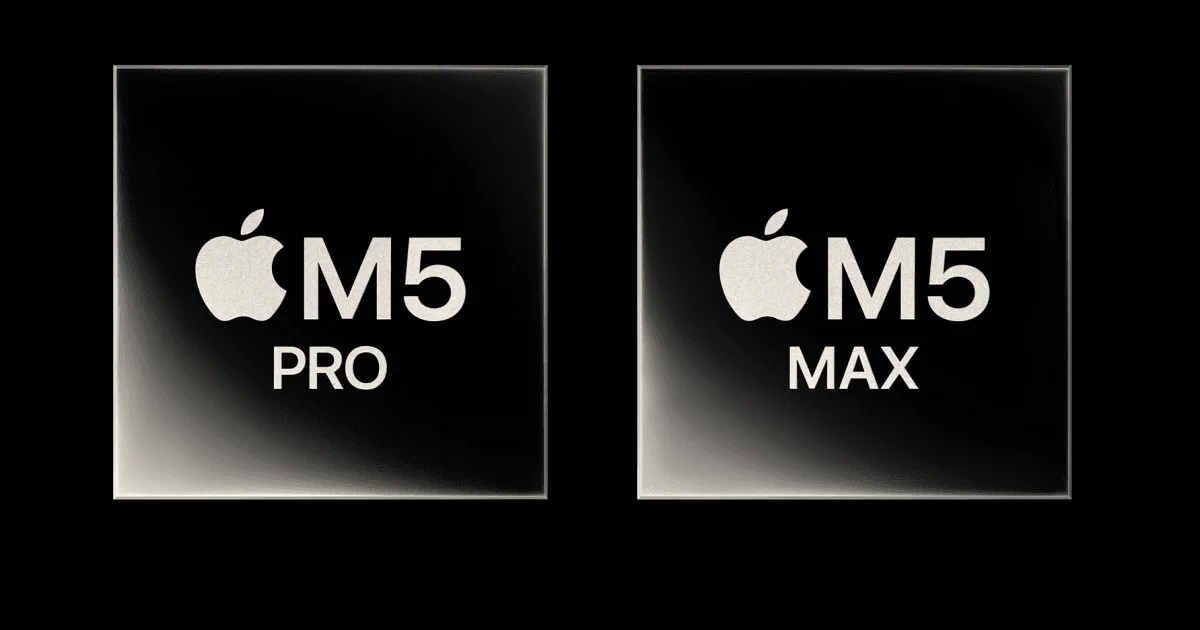
Apple on Tuesday debuted the latest additions to its M-series of silicon, announcing the new M5 Pro and M5 Max chips, which serve as the hardware platforms powering the new MacBook Pro. The chips are engineered around a Fusion Architecture, which is Apple’s design that merges two dies into a single system on a chip (SoC). This integrated architecture brings together a CPU, GPU, Thunderbolt 5 high-speed connectivity, and a Neural Engine, which functions as Apple’s dedicated AI processing hardware.
Both of the new chips feature an 18-core CPU. This configuration marks a direct upgrade from the 14-core configuration previously found in the M4 Pro, as well as the 16-core configuration in the M4 Max. The new CPU architecture consists of six “super cores”—Apple’s term for its highest-performance cores—alongside 12 all-new performance cores. Collectively, this updated CPU setup boosts performance by up to 30% for professional workloads.
For artificial intelligence and graphics workloads, Apple has significantly scaled up its graphics processing capabilities. According to Apple, a tech giant, “The GPU scales up the next-generation architecture introduced in M5 to an up-to-40-core GPU.” The company claims that with a Neural Accelerator in each GPU core and higher unified memory bandwidth, the M5 Pro and M5 Max provide over 4x the peak GPU compute for AI compared to the previous generation. Overall graphics performance is up to 20% faster, and ray-tracing workloads improve by as much as 35%.
The technical specifications for the memory and bandwidth configurations of the new silicon include:
- M5 Pro memory: Supports up to 64GB of unified memory—a memory architecture shared between the CPU and GPU—which is an increase from the 48GB configuration on the M4 Pro. It operates with a memory bandwidth of 307GB/s.
- M5 Max memory: Supports up to 128GB of unified memory, operating with an increased memory bandwidth of 614GB/s.
The new MacBook Pro models powered by these chips are scheduled to be available for preorder starting tomorrow. General retail availability and shipping for the laptops will begin on March 11.
Why it matters
The introduction of the Fusion Architecture represents a significant shift in Apple’s silicon strategy, merging two dies to deliver substantial performance gains in AI and professional computing workloads.