Chips & Hardware
Apple launches M5-powered MacBooks and entry-level MacBook Neo
Apple launched a broad hardware suite in March 2026, including new M5-powered MacBooks, an entry-level MacBook Neo, and AI-focused updates across its product lineup.
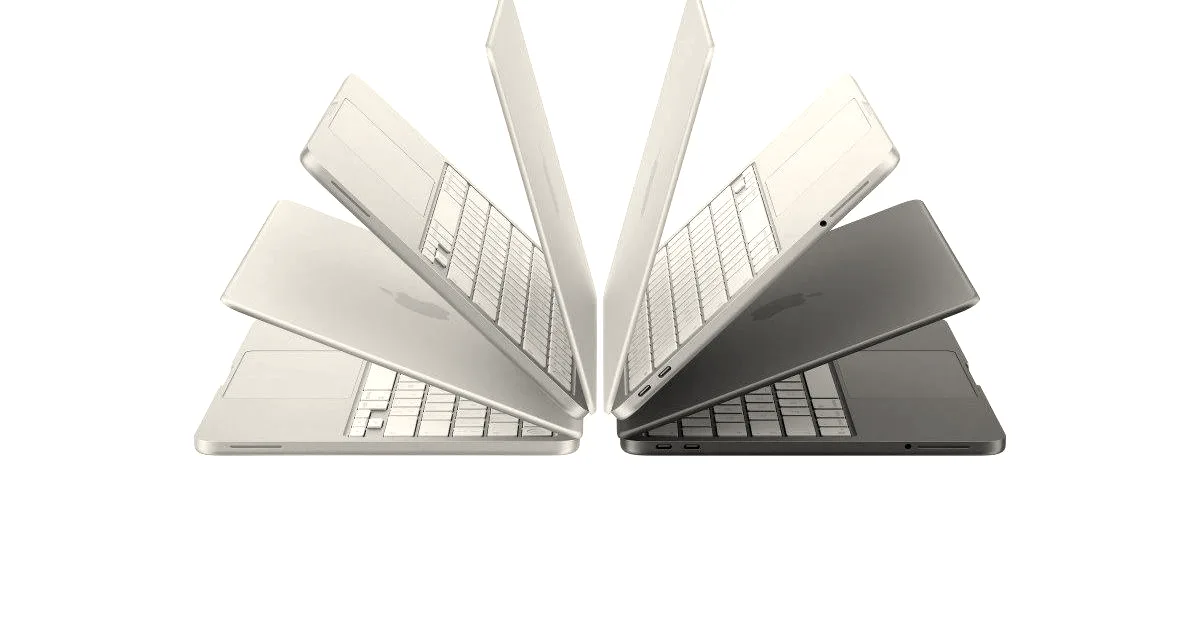
Apple rolled out a series of hardware updates in early March 2026. The announcements began on March 2 with the budget-friendly iPhone 17e and the iPad Air M4. A day later, the company announced the MacBook Air with M5 chips, new MacBook Pro models, new M5 Pro and M5 Max chips, and new Studio Display and Studio Display XDR monitors. On March 4, Apple announced the MacBook Neo, an entry-level laptop designed for students and users whose tasks do not require intensive workflows.
Central to these updates are the new M5 Pro and M5 Max chips, which are Apple silicon processor chips. Designed to accelerate AI tasks, they process large language model prompts up to 4x faster than their M4 predecessors, and generate AI images up to 8x faster than the M1 Pro and M1 Max. Both chips feature an 18-core CPU—upgrading from the 14-core M4 Pro and 16-core M4 Max—boosting performance by up to 30% for pro workloads. The M5 Pro supports up to 64GB of unified memory with 307GB/s bandwidth, while the M5 Max supports up to 128GB of unified memory with 614GB/s bandwidth.
Apple’s updated laptop lineup includes:
- MacBook Pro (M5 Pro / M5 Max): Features up to 24 hours of battery life, with fast charging to 50% in 30 minutes using a 96 W or higher USB-C adapter. The 14-inch and 16-inch M5 Pro models start at $2,199 and $2,699; M5 Max models start at $3,599 (14-inch) and $3,899 (16-inch).
- MacBook Air (M5): Offers 18 hours of battery life, a 12 MP Center Stage camera, and 512GB of base storage. The 13-inch model starts at $1,099; the 15-inch starts at $1,299.
- MacBook Neo: An entry-level 13-inch laptop running on the A18 Pro chip with a 16-core Neural Engine (an AI processing unit). It features up to 16 hours of battery life. The base model with 256GB of storage starts at $599; the 512GB model is $699. According to repairability evaluator iFixit, it is the most repairable MacBook in about fourteen years.
Beyond computing, Apple updated its mobile and audio offerings. The iPhone 17e, retailing for $599, became available on March 11. It features the A19 chip, 256GB of base storage, and a C1X cellular modem that uses 30% less energy than the modem in the iPhone 16 Pro. The iPad Air M4, starting at $599 (11-inch) and $799 (13-inch) with a $50 educational discount, is 30% faster than the M3 version and 2.3x faster than the M1 version. It features an 8-core CPU, a 9-core GPU, and 12GB of unified memory—a 50% increase—with 120GB/s bandwidth. The $549 AirPods Max 2 feature active noise cancellation up to 1.5x more effective than its predecessor. Additionally, Apple introduced the $1,599 Studio Display (over 14 million pixels, 600 nits of brightness) and the $3,299 Studio Display XDR (up to 1,000 nits SDR brightness, 2000 nits peak HDR brightness).
Why it matters
Apple’s March 2026 hardware refresh signals a strategic push to integrate AI-optimized silicon across its entire product stack, from entry-level laptops to professional-grade workstations.