AI & Models
Google uses Gemini to build global flood forecasting dataset
Google is using its Gemini model to process millions of news reports, creating a new dataset to help forecast flash floods in regions lacking weather infrastructure.
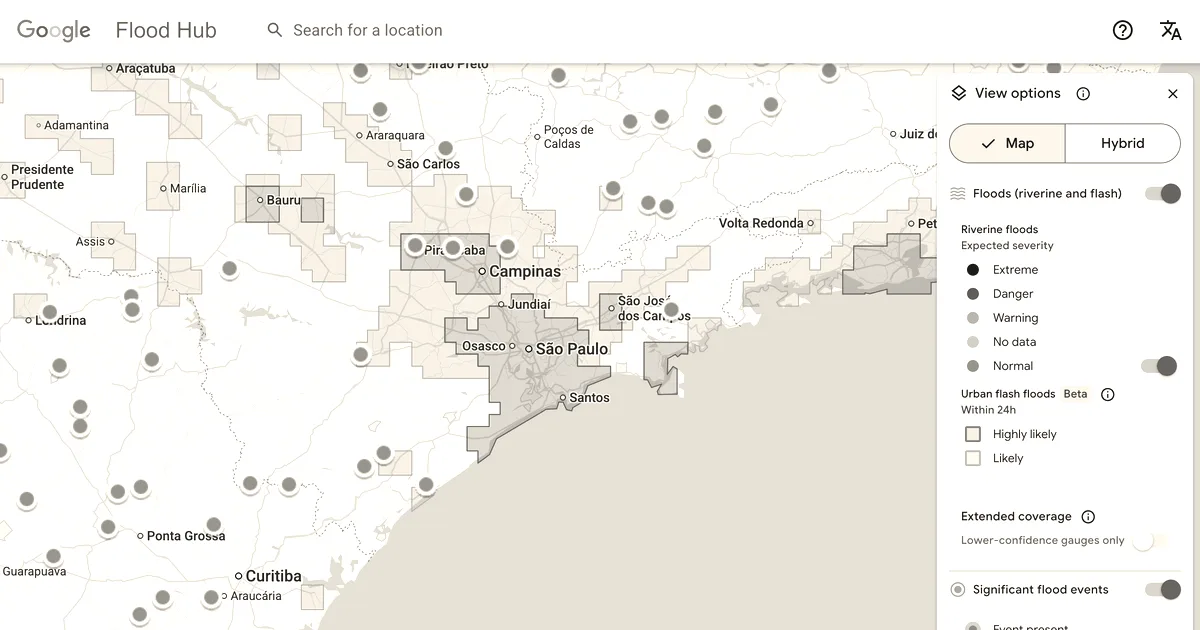
Flash floods are among the deadliest weather events in the world, killing more than 5,000 people each year. On Thursday morning, Google publicly shared research and a new geo-tagged time series dataset called Groundsource to help address this challenge. To build the dataset, Google researchers used Gemini, the company’s large language model, to sort through 5 million news articles from around the world and isolate reports of 2.6 million different floods. According to Gila Loike, a Google Research product manager, this is the first time Google has used language models for this type of work.
Using Groundsource as a baseline, the researchers trained a forecasting model built on a Long Short-Term Memory (LSTM) neural network—a type of recurrent neural network architecture—to ingest global weather forecasts and calculate flash flood probabilities. The model is currently highlighting risks across 150 countries on Flood Hub, Google’s platform for sharing flood risk data, and sharing its data with emergency response agencies around the world. However, the model has limitations. It is fairly low resolution, identifying risk across 20-square-kilometer areas, and it is not as precise as the U.S. National Weather Service’s system because it lacks local radar data.
The project specifically aims to work in regions that lack expensive weather-sensing infrastructure. Juliet Rothenberg, a program manager on Google’s Resilience team, spoke to reporters this week and explained that aggregating millions of reports helps rebalance the map by allowing the team to extrapolate to regions with less information. The forecasting model was trialed by the Southern African Development Community, an organization where emergency response official António José Beleza said the system helped them respond to floods more quickly. Marshall Moutenot, the CEO of Upstream Tech—a company that uses deep learning models to forecast river flows—noted the significance of the approach. Moutenot, who also co-founded dynamical.org to curate machine learning-ready weather data, highlighted the persistent difficulty of finding reliable baseline information. “Data scarcity is one of the most difficult challenges in geophysics. Simultaneously, there’s too much Earth data, and then when you want to evaluate against truth, there’s not enough. This was a really creative approach to get that data,” Moutenot said.
Why it matters
By using large language models to turn qualitative news reports into quantitative datasets, Google is addressing a critical data scarcity issue in weather forecasting. This approach could help provide flash flood predictions for regions that lack expensive physical weather-sensing infrastructure.