Apps & Consumer
Google's AI Overviews grow from 15% to 43% of searches in a year
Google's AI-generated search answers, known as AI Overviews, appeared in 43% of searches by mid-2026, up from 15% a year earlier, according to a new Similarweb report.
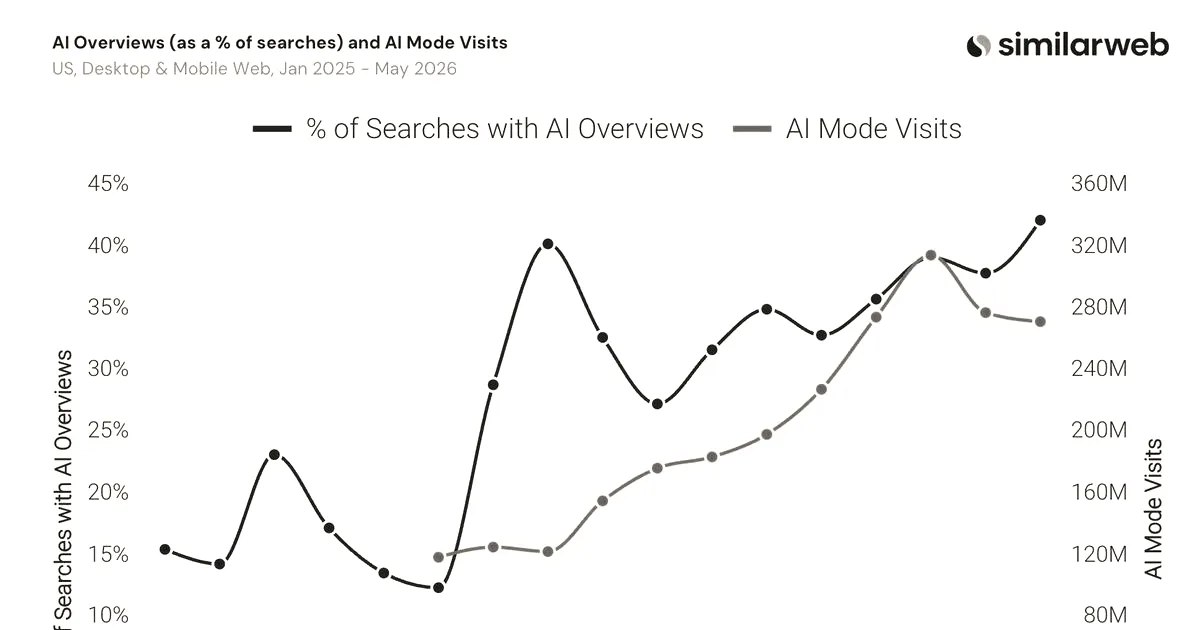
Google’s AI-generated search answers, known as AI Overviews, went from appearing in 15% of searches to 43% in the span of a year, according to a new report from market intelligence firm Similarweb, driving a broader shift in how people consume information online. Similarweb’s analysis of the generative landscape found that what began as an AI layer on top of search has become an integral part of the search journey itself, as Google routes users into AI Overviews and from there into its more conversational AI Mode. Visits to AI Mode rose from 126 million in June 2025 to 279 million by May 2026 over the same period.
The data points to a broader change in how people search the web — a shift from an era when Google offered a simple list of links to click through to one in which Google itself becomes the destination, sourcing its answers directly from the websites it indexes. That shift appears to be increasing the time users spend on Google’s own platform rather than using it purely to discover other websites; Similarweb’s data shows the average length of Google searches has risen over the past year, suggesting people are replacing short keyword searches with longer, more conversational queries designed for AI.
Publishers have not welcomed the change, as they lose referral traffic to AI citations that don’t lead to clicks — a trend Similarweb flagged as especially damaging for news publishers last year. More recently, infrastructure company Cloudflare introduced tools letting publishers block AI crawlers from their sites unless AI companies pay for access through its marketplace. The number of AI responses that include a citation has risen more than fivefold over the past year, per Similarweb’s new report, though citation rates remain low overall: just 6.8% of U.S. ChatGPT desktop queries included a citation as of May 2026, with travel, retail, and sports queries citing sources more often than other categories.
There is some hope for publishers, however: U.S. ChatGPT desktop referrals improved after a May 7 search update, with the share of visits landing on a webpage more than doubling from 25% in March 2026 to nearly 60% by May 30, 2026 — a sign that users take advantage of more prominent links in AI-driven results when they’re available. Even so, the larger trend is unchanged, as Google continues transforming itself from a gateway to the wider web into a destination in its own right.
Why it matters
As Google keeps more searches inside its own AI answers, publishers face a shrinking and increasingly citation-dependent stream of referral traffic, raising the stakes for tools like Cloudflare’s pay-for-crawl marketplace as a new revenue channel.