Chips & Hardware
Pocket raises $11M to scale its AI note-taking hardware
Pocket raised $11 million to expand its AI note-taking hardware business, which has sold more than 130,000 units since launching last year.
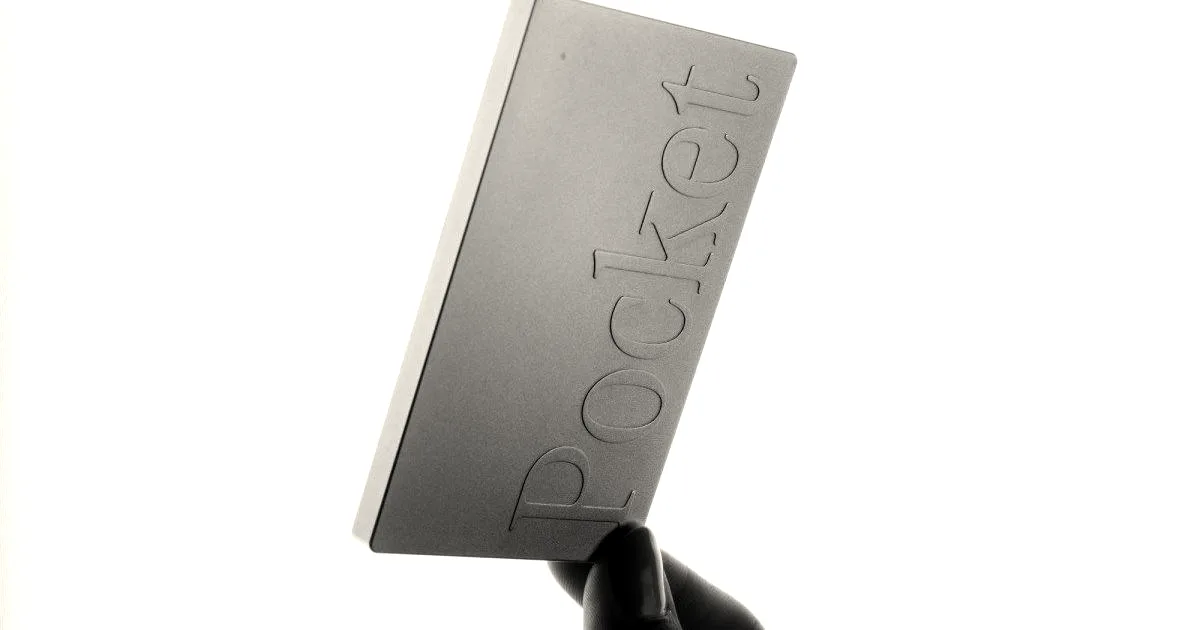
Pocket, a startup producing AI note-taking hardware, has raised $11 million in funding. The round was led by Accel, with participation from Y Combinator and ElevenLabs CEO and co-founder Mati Staniszewski. The funding follows the sale of more than 130,000 units of its device since launching last year. Pocket is attempting to differentiate itself in a crowded market of AI note-taking devices by focusing on design, pricing, and offline context.
The company was founded by Akshay Narisetti and Gabriel Dymowski. Its hardware is a $129 credit card-shaped device, or “puck,” that attaches to a phone to record and transcribe conversations. Pocket offers basic transcription features for free with the hardware, but charges a $200-per-year subscription to unlock AI summaries and assistant queries.
“We thought every meeting notetaker was built for online conversations, but nothing was geared towards real-life talk. AI really needs a lot of context to work better for us, and a lot of that context exists offline,” said Narisetti.
This focus on offline context is central to the company’s strategy. Accel partner Cecilia Wang highlighted that the device allows users to record on the go, offline, and in the field, which is how professionals like lawyers, salespeople, doctors, real estate agents, construction workers, and students use the device today. Wang noted that by capturing this offline context, users can remain present during conversations rather than shifting focus to take notes, while building a central repository of insights that might otherwise be lost.
For enterprise users, Pocket provides integrations with calendar and storage applications, alongside a model context protocol (MCP) server—a standard for connecting AI assistants to databases—to link its assistant to other databases. The company aims to help users automate tasks such as drafting emails, updating customer relationship management (CRM) systems, and creating action items based on meetings. The startup faces a crowded market of competitors, which includes:
- Hardware competitors: Plaud, which is on track to generate annual revenue of $100 million via software sales, as well as Mobvoi, Anker, Viaim, and Vibe.
- Software competitors: Granola, Zoom, Fireflies, Otter, and Read AI.
Why it matters
Pocket is attempting to differentiate in a crowded market of AI note-taking devices by focusing on design, pricing, and offline context, backed by $11M in new funding.