Apps & Consumer
Waydev research finds AI coding tools drive high code churn
Waydev data and industry research suggest that "tokenmaxxing" with AI coding tools increases code churn and costs while failing to deliver expected net productivity gains.
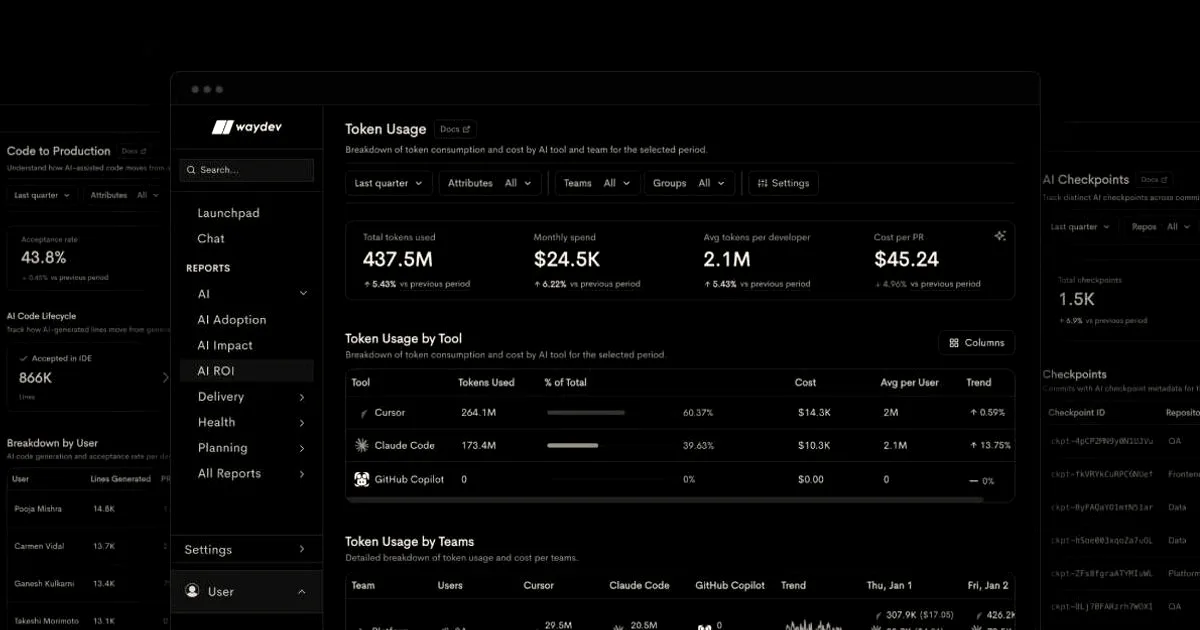
The practice of maximizing AI token usage, known as “tokenmaxxing,” has spread among Silicon Valley developers, but research suggests it is making developers less productive than they think. While engineering managers are seeing code acceptance rates of 80% to 90% for AI-generated code, they are often missing the subsequent revisions required. According to Alex Circei, the CEO and founder of Waydev, the real-world acceptance rate actually falls between 10% and 30% of generated code once revision churn is factored in. Waydev, an engineering intelligence platform founded in 2017, analyzed these dynamics across 50 different customers employing more than 10,000 software engineers. The findings suggest that while developers using tools like Claude Code, Cursor, and Codex generate more accepted code initially, they must return to revise it far more often than before.
Data from other developer analytics firms supports this trend, showing that high AI adoption leads to significant code churn—defined as the lines of code deleted versus lines added—and diminishing returns on throughput:
- In January, GitClear, a developer analytics company, published a report showing that regular AI users averaged 9.4x higher code churn than their non-AI counterparts.
- A March 2026 report from Faros AI, an engineering analytics platform, found that code churn had increased 861% under high AI adoption.
- During the first quarter of 2026, Jellyfish, an intelligence platform for AI-integrated engineering, studied 7,548 engineers and found that those with the largest token budgets—the amount of AI processing power authorized for use—produced the most pull requests, which are proposed changes to a shared codebase. However, the productivity improvement did not scale, as they achieved only two times the throughput at 10 times the cost of tokens.
This shift has caught the attention of major software companies. Last year, Atlassian, a software company, acquired the engineering intelligence startup DX for $1 billion to help organizations measure the return on investment of coding agents. Despite the challenges of managing technical debt and code quality, engineering leaders view AI integration as an inevitable transition. “This is a new era of software development, and you have to adapt, and you are forced to adapt as a company. It’s not like it will be a cycle that will pass,” said Circei.
Why it matters
The proliferation of AI coding tools is driving high volumes of code generation, but data from multiple analytics firms suggests this is resulting in disproportionate code churn and technical debt rather than net productivity gains.